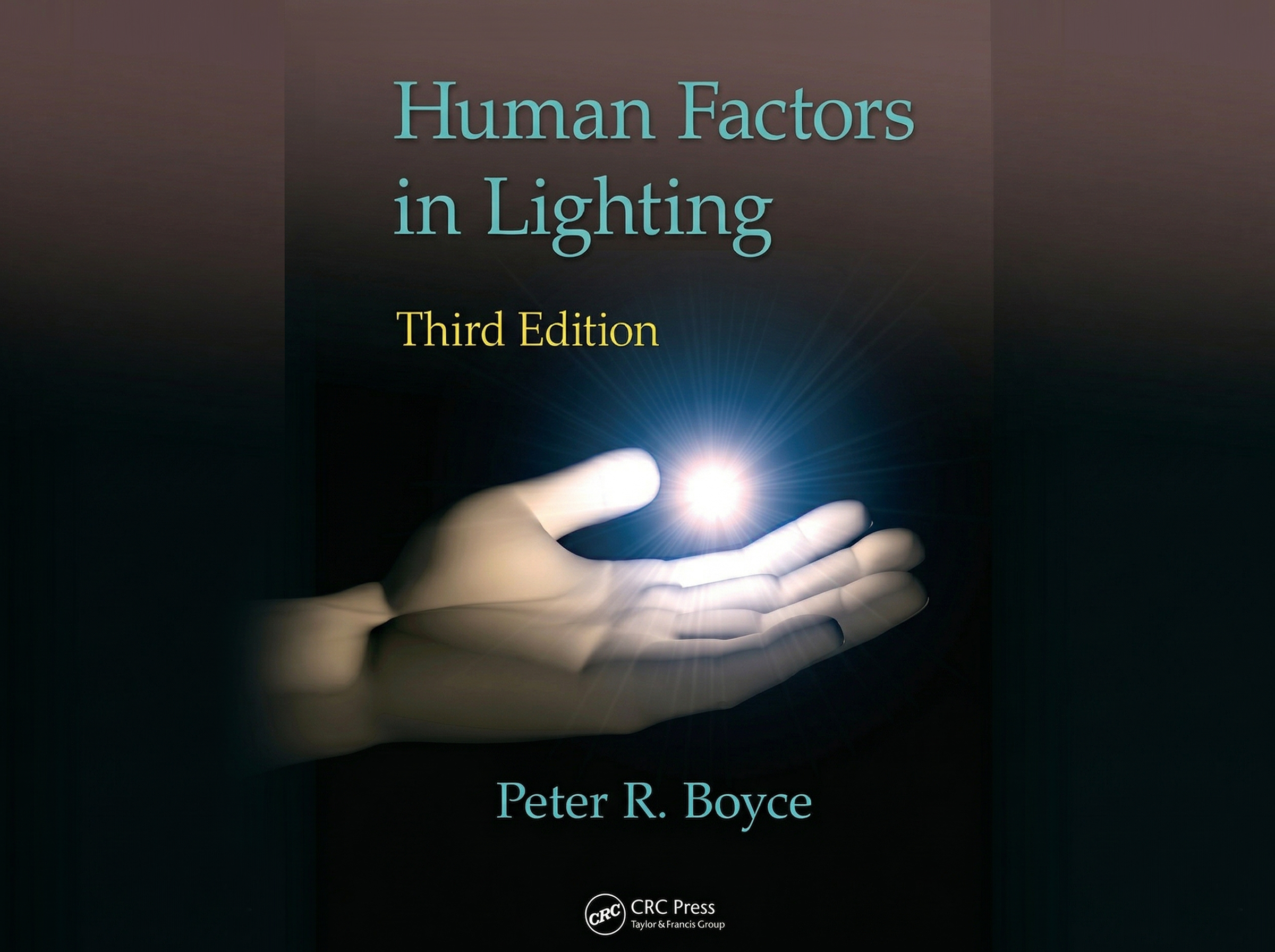
As part of its ongoing research and teaching work, Atelier dada undertook a critical reading of Human Factors in Lighting by Peter R. Boyce, 3rd edition, CRC Press, 2014, first published in 1981. This third edition expands a landmark reference with new chapters on the non-visual system, pedestrian lighting, light pollution, and the relationship between lighting and energy use, while updating the book in light of the advances of the previous decade.
For Atelier dada, the value of this book is very specific. Boyce does not offer a design method. What he does offer is a clear framework for understanding the perceptual variables without which no architectural lighting project can be built on solid ground. He addresses the visual system, its continuous adjustments, adaptation, photopic, scotopic and mesopic vision, then visibility, threshold conditions, visual performance, glare, veiling reflections, brightness and visual clarity. In doing so, he gives a name to what makes a scene readable or unreadable, stable or unstable, tiring or comfortable, blurred or clear to the eye. He also makes one point unmistakably clear: these thresholds only make sense within the perceptual conditions that produce them. They are not figures to be imposed on a project, but reference points that help us understand when, and under what conditions, a scene becomes truly legible.
This same caution applies to the age of the observer. The third edition includes an entire chapter on "Lighting for the Elderly", examining age-related optical changes, their effects on visual abilities, real tasks, and ways of compensating for them. Earlier in the book, Boyce also reminds us that pupil size varies not only with the light reaching the retina, but also with the age of the observer. This means that the same lighting level is not received in the same way by every eye, and that visibility thresholds can never be read as universal truths independent of the person who is looking.
This is precisely where the book becomes truly useful to architectural lighting design. It helps explain why a space may be generously lit and still remain poorly read: adaptation badly prepared, the visual threshold too close to its limit, useful contrast too weak, relief dissolved by a stray reflection, a background that dominates too much, disturbing brightness, a task too fine for the actual observer, or the implicit assumption of a standard eye that does not exist. It also helps identify when a scene has already moved beyond the point at which additional light improves legibility.
Conversely, a more restrained scheme can produce an immediate and stable reading when luminances, differences, directions, transitions, and the very nature of the visual task are calibrated with accuracy. Boyce is especially valuable here because he connects measurable aspects of the visual field with measurable human responses; visual performance is defined in terms of the speed and accuracy with which visual information is processed.
Boyce therefore works at a fundamental level: the basic perceptual conditions of seeing. He clarifies the consequences, for any project, of a visual field that is poorly tuned, and he stabilises the conditions on which vision depends.
Design, by contrast, operates at a finer level. It decides what should appear, in what order, with what restraint, for what use, and with what quality of presence. It gives spatial meaning to what deserves to be seen. This layer does not contradict Boyce. It builds on him.
For Atelier dada, reading Boyce means restoring metrics to their proper place. They are neither a sufficient truth nor a secondary language. They describe an essential part of perceptual reality. But they only become meaningful when tied to a scene, a task, a state of adaptation, and a real observer, with age, limits, and a particular way of looking. Only then can design fully take over.
© MI. Bouhlel, Atelier dada. All rights reserved.
The texts, concepts, and reflections published on this website may not be reproduced, adapted, or distributed without prior authorization.