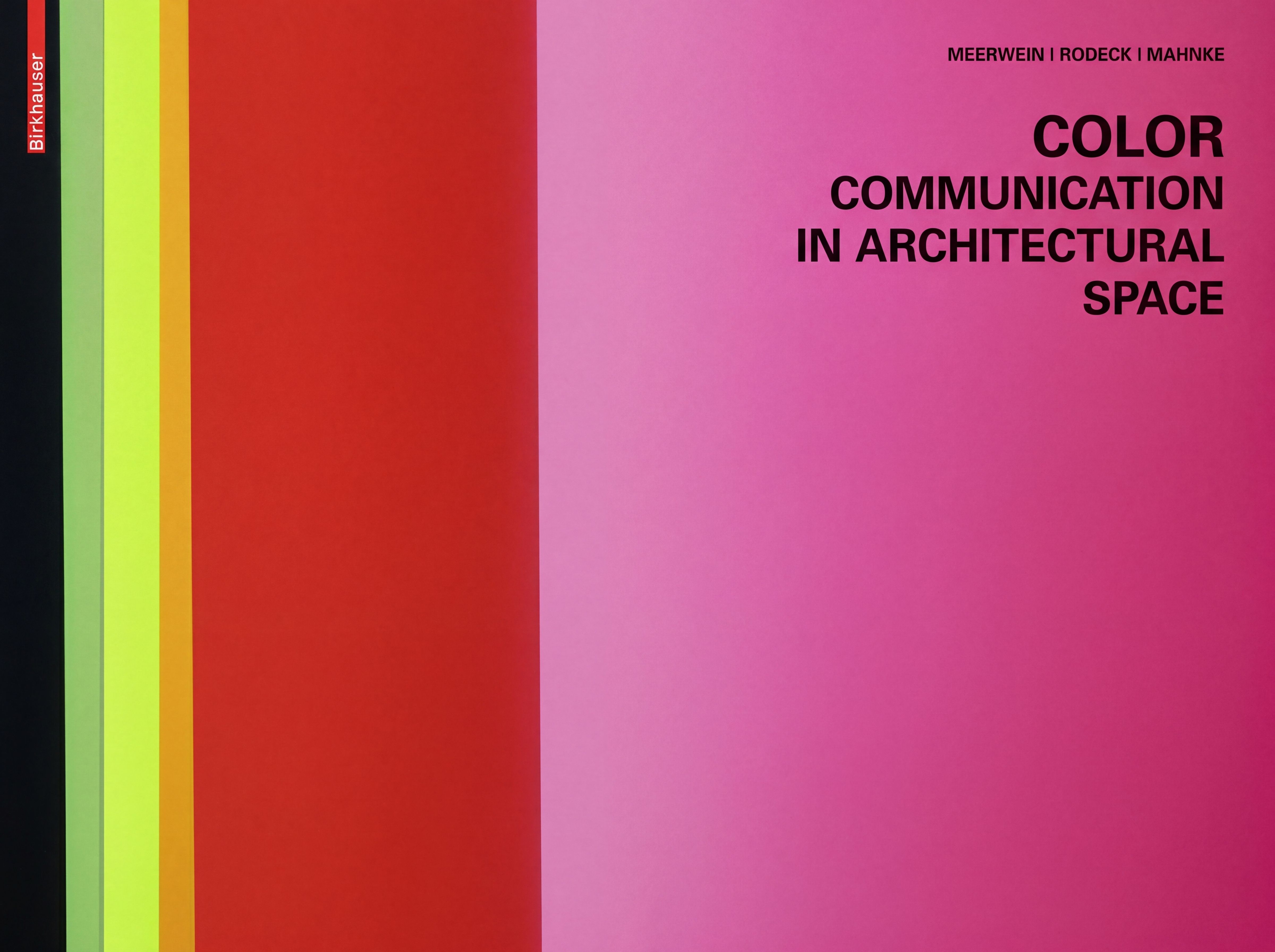
To think about colour in space is to enter a moving matter.
A colour rarely appears alone. It appears with light, on a surface, within a depth, according to an angle, a duration, a memory of the gaze. It depends on the material that carries it, the light that reveals it, the eye that adapts to it, the body moving through the place.
This is the complexity that Color Communication in Architectural Space allows us to reopen with precision.
First published in 1998, then expanded in its 2007 English edition with insights from environmental psychology, Harald Meerwein, Christine Rodeck and Frank Mahnke’s book remains an important reference for spatial designers. It approaches colour as a perceptual language, capable of influencing orientation, attention, visual hierarchy and the emotional quality of places.
One of the most useful passages concerns the way colours are distributed in space. The authors distinguish dominant surfaces, subdominant surfaces and accents. This apparently simple distinction provides an effective tool for reading the composition of a place.
The dominant surface establishes the general climate. The subdominant surface modulates the balance. The accent attracts the eye, creates a tension, sometimes indicates a threshold, a direction, a presence.
To this hierarchy is added the role of light/dark contrasts. A large dark surface can bring a boundary closer. A light surface can open perception. A localized contrast can guide the gaze without relying on explicit signage. In the diagrams of the book, simple variations of brightness between dominant, subdominant and accent are enough to transform the perception of the same space.
The pages devoted to floor, walls and ceiling extend this logic. A colour does not produce the same effect depending on the surface that receives it. The floor immediately engages a relation of weight, support and stability. Walls strongly contribute to the overall atmosphere and to the reading of limits. The ceiling affects the perception of height, shelter, compression or openness.
Colour then becomes an architectural instrument in its own right. It participates in the way space holds itself, expands, contracts, orients and allows itself to be crossed.
What still makes the book valuable today is its constant attention to context.
The authors remind us that colour has no universal meaning. Its perception depends on many parameters: culture, age, memory, function of the place, uses, duration of exposure, position in space, material quality, type of light. The same hue can produce very different impressions depending on its intensity, nuance, surface, environment and the user’s experience.
The book is particularly clear on this point when dealing with material colour. It warns against quick associations. It reminds us, for instance, that green cannot simply be described as calming. Nuance, saturation, material, cultural context and use situation deeply change its effect.
This caution makes the moment when the book addresses the relationship between light and colour even more interesting.
In the chapter devoted to light and colour, the authors first recall essential points for designers: light and colour are inseparable in the process of perception; the quality of light modifies the appearance of hues ; luminance, more than illuminance alone, conditions the sensation of brightness ; materials, colours and light must be considered together.
In the authors’ analysis, the light being studied is mainly white light, natural or artificial, acting on surfaces, materials, contrasts and luminance levels.
This basis remains essential, because it confirms that material colour never exists alone: it always appears within a given lighting situation.
When the text more directly evokes the physiological effects of coloured stimuli, the discourse becomes more condensed. Certain associations, such as red light stimulating, blue light calming, green light balancing or yellow light uplifting,... appear as psychophysiological markers. They open a useful path, but they do not yet unfold the full complexity of coloured light understood as a situated architectural medium.
This passage calls for careful reading.
Without reducing the value of the book, one can distinguish a methodological limit that this rereading seeks to extend, almost twenty years after the expanded English edition. Since then, LED systems (light-emitting diodes) RGB (red, green, blue), RGBW (red, green, blue, white), RGBCW (red, green, blue, cold white, warm white), precision optics, dynamic controls and addressable systems have deeply transformed practices.
Chromatic light is now present in public spaces, interiors, cultural venues, nightscapes, immersive environments, façades and domestic spaces. It has entered the common grammar of architecture and lighting design.
This evolution requires us to refine the way we think about it.
Coloured light may act on very neutral, almost silent surfaces, where it becomes the main chromatic presence of the place. It may also move through a space already rich in material colours, where it encounters pigments, more or less neutral or coloured, wood, stone, metal, textiles, gloss, matte surfaces and transparencies.
Most often, it acts in intermediate situations, where the colour of light, the colour of matter, shadow, reflection and visual adaptation compose a more complex experience. This continuum of situations must be studied according to each context.
On a matte white surface, coloured light may almost seem to lay down a temporary skin.
On a glossy material, it fragments, reflects and shifts with the gaze.
On warm wood, a cool light may alter the perceived balance of the material.
On beige stone, an amber light may reinforce mineral density.
On an already coloured paint, it may reveal, mute, contradict or shift the initial hue.
The phenomenon is born from encounter. This encounter involves surface reflectance, texture, gloss, beam direction, lighting level, saturation, spatial distribution, duration of exposure and the adaptation of the eye. It also involves quieter dimensions: the use of the place, its memory, its cultural charge, the rhythm of movement, the expectations of those who inhabit or cross it.
Coloured light does not work as an emotional command. It modulates a situation by transforming relations: between a body and a wall, between a material and a shadow, between a depth and a threshold, between a visual memory and a present experience. It may accentuate an existing tension, soften a boundary, disturb a reading, amplify an orientation, reveal a latent dimension of the place.
Coloured light must then be thought of as a relational medium. It modulates the way a particular space is perceived, felt, crossed and remembered, opening a more unstable zone where space becomes variation, interaction, transformation.
The question is therefore not only: which colour of light should be chosen?
It becomes instead:
What does this coloured light do here, now, with this architecture, this memory, this identity, these materials, these uses, these bodies…?
In this question, colour regains its depth. And light, its ability to transform space with precision and care.
At Atelier dada, this research runs through our way of approaching places: starting from what already exists, reading materials, thresholds, uses and memories, then seeking the luminous nuance able to open a more accurate relationship between architecture and those who move through it.
Studied source:
Color Communication in Architectural Space
Harald Meerwein, Christine Rodeck, Frank Mahnke
Birkhäuser, 1998. Expanded English edition, 2007.
© MI. Bouhlel, Atelier dada. All rights reserved.
The texts, concepts and reflections published on this website may not be reproduced, adapted or distributed without prior permission.