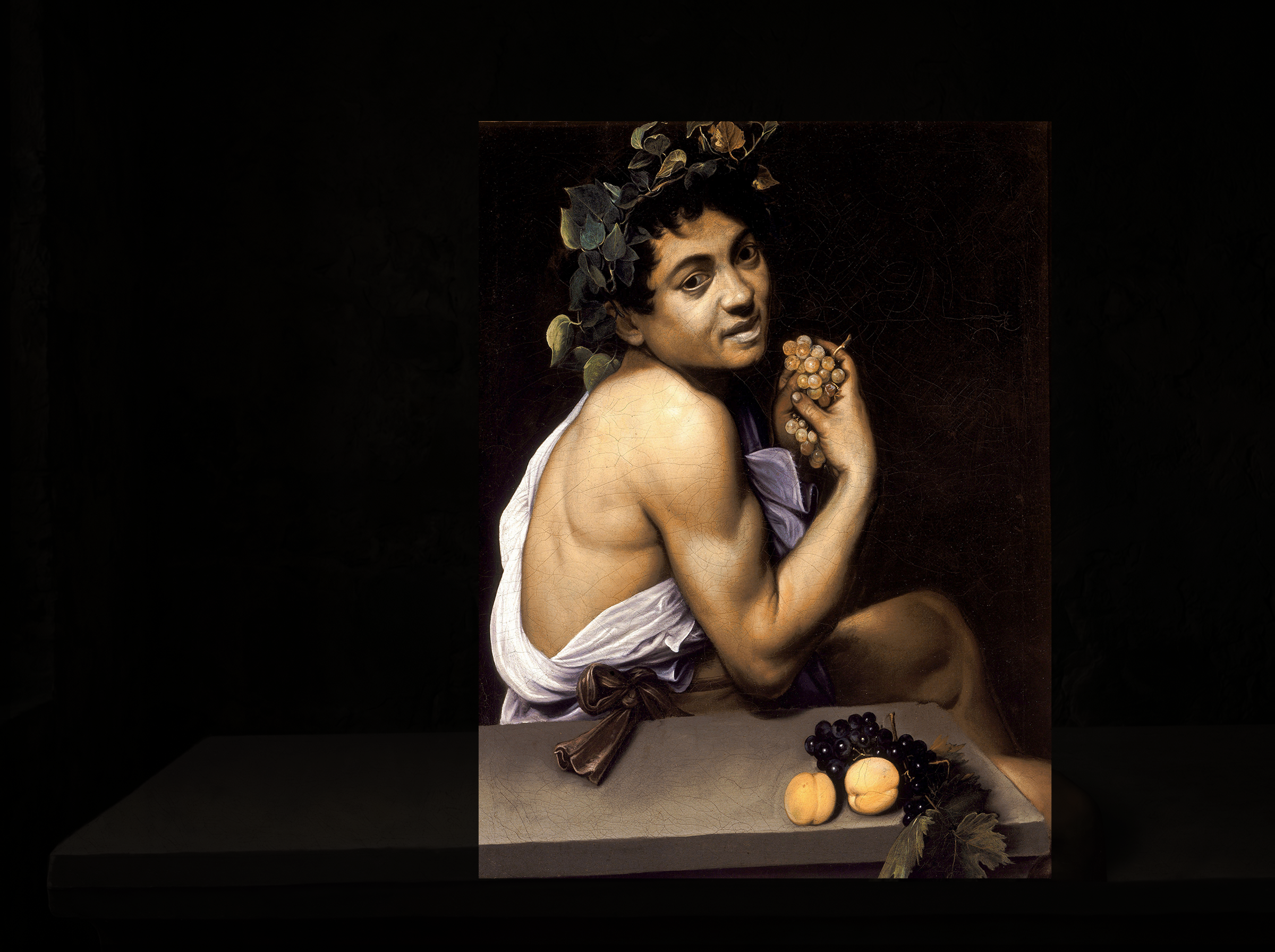
This essay revisits and extends a LinkedIn post written, by Marie-Ikram Bouhlel, after reading an article by a fellow researcher in architectural lighting design. His text encouraged us to return to Caravaggio, one of the painters whose pictorial universe has always drawn us in, and whose film Caravaggio’s Shadow by Michele Placido, 2022, also nourished our gaze.
In the deep darkness of his studio, whose walls he had painted black, Caravaggio, Michelangelo Merisi da Caravaggio, known in French as Caravage or Le Caravage, was not seeking a decorative chiaroscuro. He was constructing an absorbent environment to cancel unwanted reflections, concentrate the light, and reveal with precision what he wanted to bring out of the shadow.
Darkness was structure, not absence.
Through this approach, Caravaggio was not simply painting illuminated subjects. He was staging the very conditions of perception. By absorbing stray reflections from his environment, he created a frame in which every luminous nuance became meaningful.
In other words, Caravaggio was already working with what we now call luminous hierarchy: a few illuminated surfaces, many surfaces held in reserve, and a controlled contrast to guide the eye.
As Richard Caratti-Zarytkiewicz reminds us in his article “Caravaggio’s mastery as a modern lighting designer’s reflection”, this approach went far beyond a simple aesthetic effect. Caravaggio physically observed the effects of light in the real space of his studio. His black walls allowed him to control peripheral reflectance, concentrate contrasts, and explore that mysterious threshold between visibility and darkness that Leonardo da Vinci described as “tenebrae”, one of the very first degrees of shadow.
Today, lighting designers operate in a very different context: that of an open, living city, saturated with diverse lighting and stray light. We no longer have the natural darkness of the night, and rarely the silence of an enclosed space. Guiding the gaze toward that threshold of perception sometimes becomes almost impossible.
And yet, the gesture remains the same.
To create conditions for perception.
To choose what should appear.
To leave in shadow what can, or must, remain withdrawn.
Where Caravaggio sculpted mystery within an extremely controlled frame, contemporary lighting designers now sculpt legibility in an unstable world. Where he guided the gaze within a painting, we accompany bodies through architectural and urban space, in dialogue with uses, rhythms of life, nocturnal landscapes, and the multiple luminous layers that now compose our cities.
The parallel then becomes particularly interesting.
Caravaggio worked within a deliberately absorbent environment in order to give light its full expressive power. The lighting designer, in contrast, often tries to recover a form of perceptual silence within the luminous noise of the contemporary world. Not to artificially recreate a supposed past, but to restore order, breathing space, and meaning.
At a time when energy sobriety and light pollution have become major issues, this attention to shadow as a resource for perception, rather than as a lack of light, also opens highly contemporary paths.
This reflection reminds us that shadow is not the enemy of light. It is its condition.
Without darkness, there is no depth, no contrast, no tension, no revelation.
In a world where cities are becoming increasingly luminous, where the image must be immediately and everywhere visible, Caravaggio’s thought reopens an essential question: how can we still leave room for mystery, nuance, and the gradual adaptation of the gaze?
Perhaps this is one of the most contemporary lessons of his work. To learn how to better construct the conditions in which light becomes perceptible, legible, and emotionally meaningful.
At Atelier dada, this reflection nourishes our project choices: accepting a part of darkness, working with contrasts, and conceiving each luminous situation as an experience of perception rather than a mere level of illumination.
Source studied:
Richard Caratti-Zarytkiewicz, “Caravaggio’s mastery as a modern lighting designer’s reflection”, IEEE Sustainable Smart Lighting World Conference & Expo, LS24, 2024. Read it on Academia
Image source:
Michelangelo Merisi da Caravaggio, Young Sick Bacchus, also known as Self-Portrait as Bacchus, c. 1593–1594, Galleria Borghese, Rome.
Image: Caravaggio, personal digitization, public domain, Wikimedia Commons.
https://commons.wikimedia.org/w/index.php?curid=15219686
© MI. Bouhlel, Atelier dada. All rights reserved.
The texts, concepts, and reflections published on this website may not be reproduced, adapted, or distributed without prior authorization.