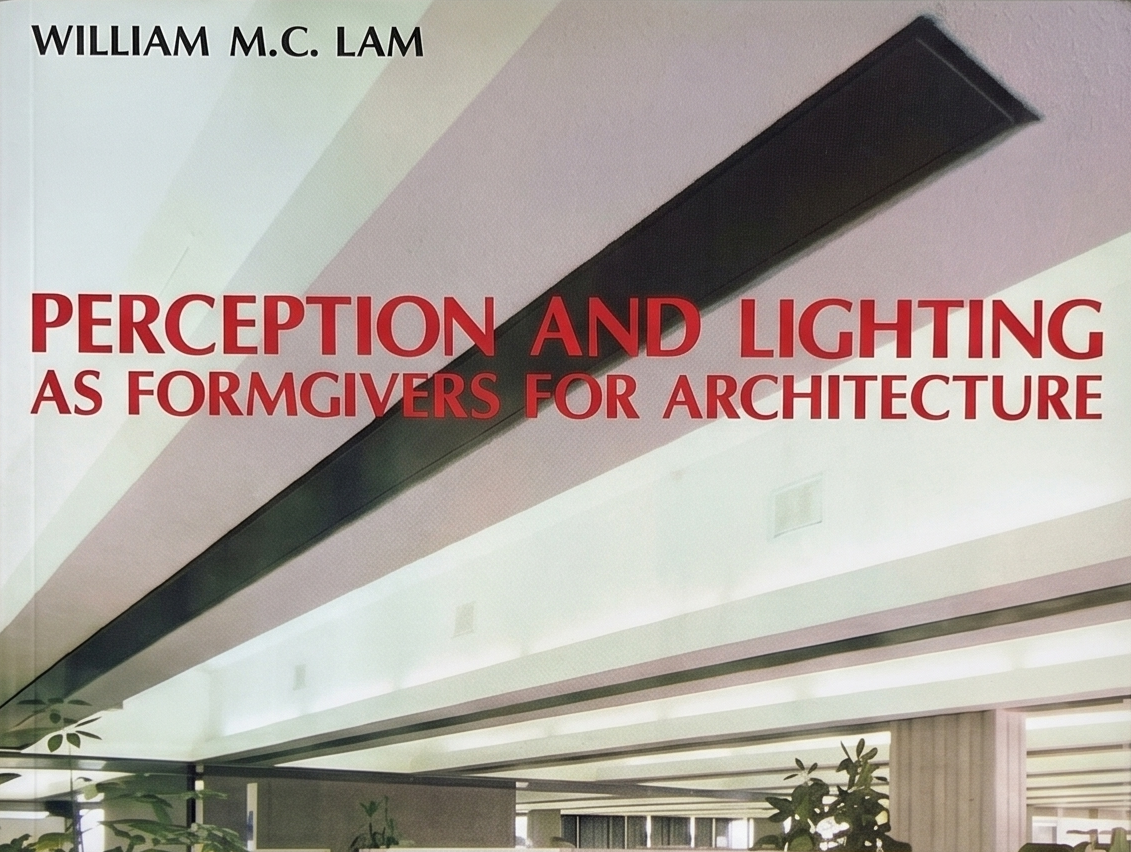
Published in 1977, Perception and Lighting as Formgivers for Architecture occupies a singular place in the literature of architectural practice: neither a simple lighting manual nor a purely theoretical treatise, William M.C. Lam’s book reframes light as an operator of perceptual structure rather than a mere quantitative variable.
Almost fifty years later, reading Lam produces a double effect. On one side, his principles feel familiar, almost self-evident. On the other, they collide with many contemporary practices where an abundance of technical means does not always translate into clearer perception.
Light as a selection of information
Lam shifts the project question: it is not primarily about how much light is needed, but about what visual information must be made available.
Every space is saturated with stimuli: surfaces, volumes, reflections, signs, movements, faces, obstacles. Human perception is limited; it constantly filters and selects. Light operates at this level as a tool of hierarchy: it distributes salience, organises figure-ground relations, and composes a structure of reading rather than just a condition of visibility.
In this perspective, bad lighting is not only insufficient lighting. It is lighting that is misdirected in informational terms: it gives importance to secondary elements, blurs reference points, and produces noise where perceptual structure is expected.
Visibility, recognition, legibility
One of Lam’s most operative contributions is his distinction between visibility, recognition and legibility.
Visibility refers to detecting presence: a step, an obstacle, a threshold. Recognition concerns identification: understanding that a form is a stair, a bench, a piece of art, a face, which requires readable relief, material and contours. Legibility finally operates at the scale of spatial structure: understanding where one is, how routes, hierarchies and transitions between public and intimate zones are organised.
This framework helps diagnose a frequent drift today: the overinvestment in visibility : often through over-lighting or spectacular emphasis, at the expense of fine recognition and overall legibility. Space becomes immediately perceptible, but not truly intelligible.
Against the reduction to illuminance levels
Lam writes in a context strongly marked by illuminance standards and performance rationalisation.
He does not reject these tools, but questions their claim to be sufficient grounds for design decisions. His analysis of diminishing returns remains sharply relevant: beyond a certain threshold, increasing the quantity of light generates marginal, sometimes null, gains for vision, while other parameters : contrast, direction, apparent size, control of reflections, become decisive.
This critique resonates in an era where technological sophistication : layered lighting schemes, dynamic scenes, complex control systems, can easily substitute for perceptual necessity instead of serving it.
Visual noise as a critical tool
The notion of “visual noise” is one of Lam’s most fertile contributions.
Visual noise is not only about glare. It designates any solicitation that attracts attention without necessity: a luminaire that imposes itself as an object, a luminous surface without content, a ceiling pattern competing with the space, a contrast that rivals the primary subject. Lam invites us to think of comfort not only as absence of discomfort, but as absence of unnecessary solicitations.
This critical tool is particularly useful when looking at certain contemporary productions: effect-driven layering, permanent interactive setups, accumulation of luminous cues that eventually flatten any hierarchy. In such cases, light stops organising perception and turns into an unfiltered flow of information.
Media architecture : model, drift and alternative uses
Media façades often offer an extreme example of light as image rather than as a simple condition of vision. In certain hyper‑commercial districts : from Times Square in New York or the Las Vegas Strip to specific urban centres in China, these systems become full‑scale urban screens, entirely devoted to commercial communication, saturating the visual field and generating significant luminous, energetic and ecological excess.
Yet it would be reductive to equate every media façades with this paradigm. In some other parts of the world, the same technology has supported more situated projects like those realized by Atelier dada for example : façades that extend architectural structure over time, devices that work with local narratives, or interventions where light operates as a poetic and contextual medium rather than as a mere support for messaging.
The question, then, is less whether to condemn or celebrate media architecture, and more whether they reinforce the legibility and identity of a place, or simply import a standardised spectacular model at the cost of visual, energetic and ecological imbalance.
The window as information
Lam’s pages on natural light remain highly current.
For him, a window is not merely a luminous opening, but a vector of information: time, weather, sky, depth and movement outside. It inscribes users in a continuity with the world beyond. Conversely, some contemporary solutions : heavily filtered glazing, extensive translucent skins, artificial sky ceilings, provide comfortable light but impoverished information.
In a context where natural light is often reduced to energy metrics or comfort indicators, Lam reminds us that it belongs to a broader perceptual ecology, touching both physiology and symbolic relation to place.
A method rather than a model
Lam’s book bears the marks of its time: project typologies, technical references and a modernist imagination.
It does not offer a model to replicate, nor a lighting style to imitate. Its strength lies elsewhere: in the way it forces simple yet demanding questions before any technical decision. What is the real perceptual need? What information must be made available? Which element should emerge, which should remain in the background? What helps orientation, and what generates noise?
In a field where light is increasingly asked to produce effects, images or signatures, Lam acts as a counterweight. He reminds us that light truly gives form to architecture only on the condition that it does not seek, first of all, to put itself on show.
© Atelier dada. All rights reserved.
The texts, concepts, and reflections published on this website may not be reproduced, adapted, or distributed without prior authorization.