A boy of eight, blind since birth, undergoes surgery in 1910. His eyes are healed.The bandages come off.
A hand moves before him.
“What do you see?”
“I don’t know,” he says.
The doctor moves his hand again.
“Don’t you see it moving?”
“I don’t know.”
His eyes work. Yet they do not follow. What reaches him is only a varying brightness, without contour, depth or hold.
Then he is allowed to touch the hand as it moves, and he cries out, in triumph: "It's moving!" He can feel it move. He can, as he says, hear it move. But he must still learn, laboriously, to see it move.
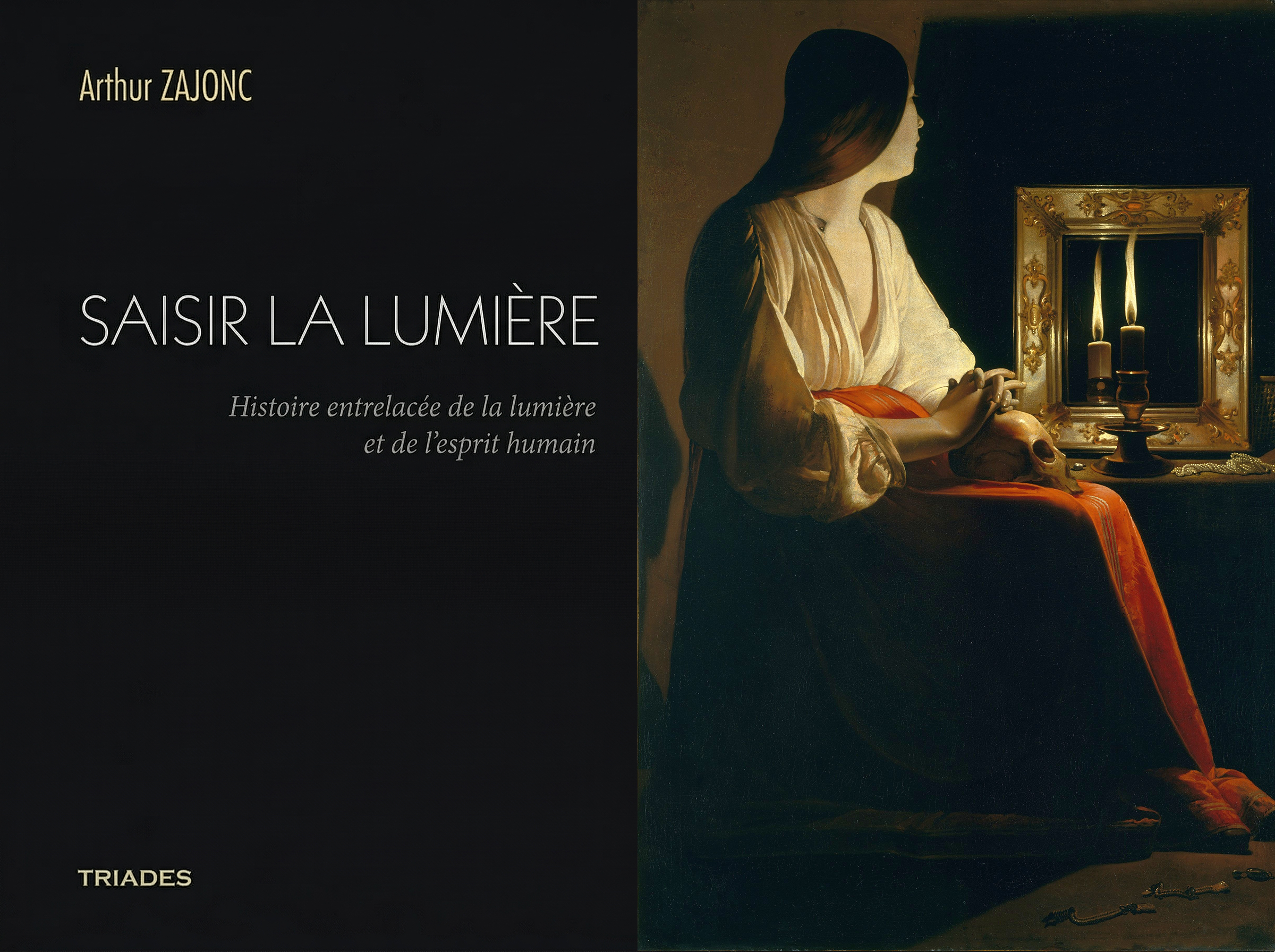
The case recounted by Arthur Zajonc touches the heart of the book: light may reach the eye without vision having yet been born. Seeing asks for the meeting of two lights: the light of nature, and a light of mind that must be built, patiently, out of touch, sound, memory and time. Before a face, a hand, a movement can become presence, cognition must first learn to recognise, connect and organise what arrives as mere brightness.
Some patients, faced with this new and overwhelming language, chose to return to blindness. Zajonc records this too: proof of how fragile, and how learned, the gift of sight really is.
From that threshold, the book unfolds a long history, almost a migration of consciousness across the centuries. Light changes language and face.
In Egypt, the nature of light admitted no ambiguity: light was the sight of a god. The sun was the eye of Ra, not his symbol but literally his eye, and his vision was the world's life itself. A Turin papyrus from around 1300 BCE has Ra say: "I am the one who openeth his eyes, and there is light; when his eyes close, darkness falleth." To stand in daylight, for the Egyptians, was to stand inside the gaze of a god: to be seen was to be alive, to be lit was to matter. Another myth tells of the eye that wandered from its place as the sun and was lost in the world's depths, until Thoth found and healed it, and Ra set it, restored, upon his own forehead, where the sacred serpent now coils around it to guard it, a fire keeping watch through the night; this same adornment the pharaoh would wear in turn. Human sight held no light of its own in this order: to see was to stand inside a brightness entirely on loan from the god. Light was not something god made. Light was god seeing.
With the Greeks, this fire changes hands. What Egypt reserved for a god, and through him for the pharaoh alone, who wore that eye upon his own brow, Empedocles and Plato hand to every human eye. Aphrodite does not kindle one sacred flame on one sovereign's forehead; she fits a lantern into each eye at birth, indiscriminately. The inner light that sees is no longer a royal privilege. It becomes, simply, a human endowment.
In Greece, light mingles with the inner fire of sight, literally. For Empedocles, the eye is a lantern: Aphrodite lit a fire within it, and to see is to send that fire out, to meet the daylight half way. Plato, in the Timaeus, keeps the image and gives it a mechanism: the fire of the eye issues a gentle light that coalesces with the daylight, like to like, forming a single body of light, the bridge along which the world reaches the soul. Seeing, for the Greeks, was never reception. It was encounter, forged at the meeting point of two lights.
Each civilisation, in this sense, learns to see differently. Light does not only illuminate things: it illuminates the way a culture learns to name, sense and order the visible.
Then the gaze tightens. Light enters the dark chamber. It is refracted through the prism, divided, measured, turned into law.
This moment carries the grandeur of the great intellectual conquests.
Around the year 1000, Ibn al-Haytham (Alhazen) lays the foundations of a rigorous optics. Six centuries later, Kepler refines the mechanics of the eye itself. A century after him, Newton turns the prism into law. And all those who follow them give humanity an extraordinary precision. The visible becomes calculable. Colour unfolds into spectrum. Space yields to modelling. The world gains a new sharpness. And yet, beneath this victory, another question begins to pulse: what becomes of the living experience of sight when light is grasped above all as quantity, trajectory, particle or wave?
With Goethe, a century after Newton, light regains contact with the lived world. Colours arise at the edges, in the unstable place where brightness meets obscurity. The phenomenon recovers its thickness. The observer recovers a place within it. Seeing becomes participation again.
The journey continues through Faraday, Maxwell, Einstein, Planck, Bohr and Feynman, across the nineteenth and twentieth centuries. And the further light advances through the history of science, the more subtle, mobile and elusive it becomes. Field, wave, quantum, limiting speed, probability, mathematical beauty: each theory approaches it with renewed intensity. Science grows finer, mystery grows deeper. In these pages, light becomes a trial for intelligence itself. It compels thought to remain supple, to accept that the world is given in layers, in intervals, in successive revelations.
Alongside this, Cézanne appears as a natural companion to this line of thought. Before the landscape, he looks for a long time. He returns. He waits. Mountain, water and trees shift in appearance, hue, intensity and colour relationships with time and attention. Painting becomes inquiry. It studies the visible as science does, otherwise, with another patience, another tool, another fidelity. Art enters the investigation and reminds us that vision is built through duration, that colour lives through relations, that form arrives slowly in consciousness. The gaze becomes a passage through which the world remakes itself.
What Zajonc leaves behind belongs to a conversion of the gaze, in which light is approached as a physical, cultural, mental and poetic reality all at once. To know asks for more than explanation. To see asks for more than reception. The observer fully belongs to the adventure of the visible.
To catch the light is then to catch something more inward, at the very point where perception becomes consciousness.
For those who design with light, the lesson is direct. To place light in a space is never only to illuminate it. It is to shape the conditions under which someone, standing there, will learn to see.
At Atelier dada, this reading is one of the references that continue to nourish our approach to perception and the visible. It draws here on Arthur Zajonc, Saisir la lumière: Histoire entrelacée de la lumière et de l'esprit humain, Éditions Triades, 2017, French translation of the work first published in English under the title Catching the Light: The Entwined History of Light and Mind in 1993.
© MI. Bouhlel, Atelier dada. All rights reserved.
The texts, concepts and reflections published on this website may not be reproduced, adapted or distributed without prior permission.