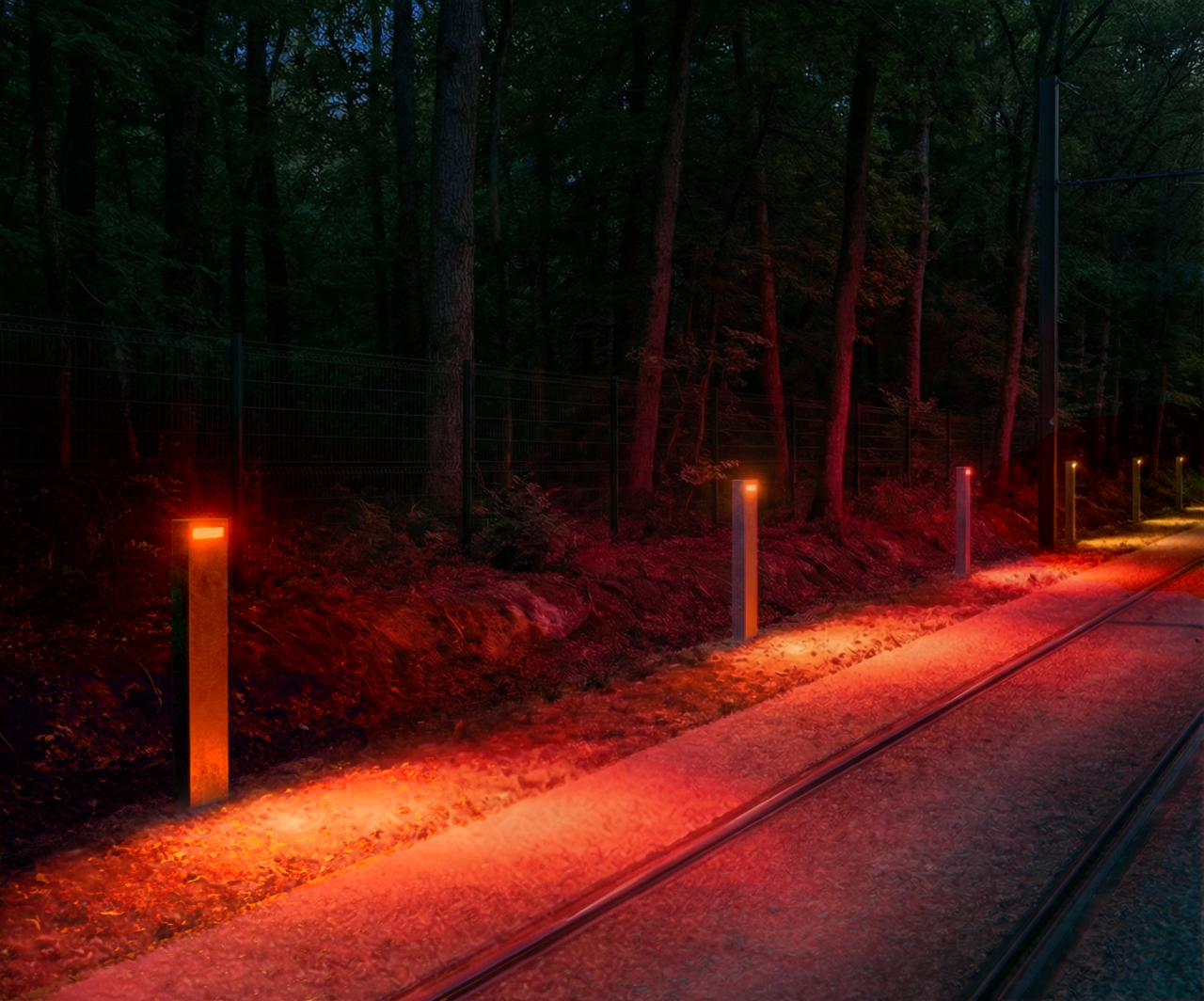
Chromatic Crossing — Saint-Germain-en-Laye Forest, Tram T13
Lighting a living environment without altering it
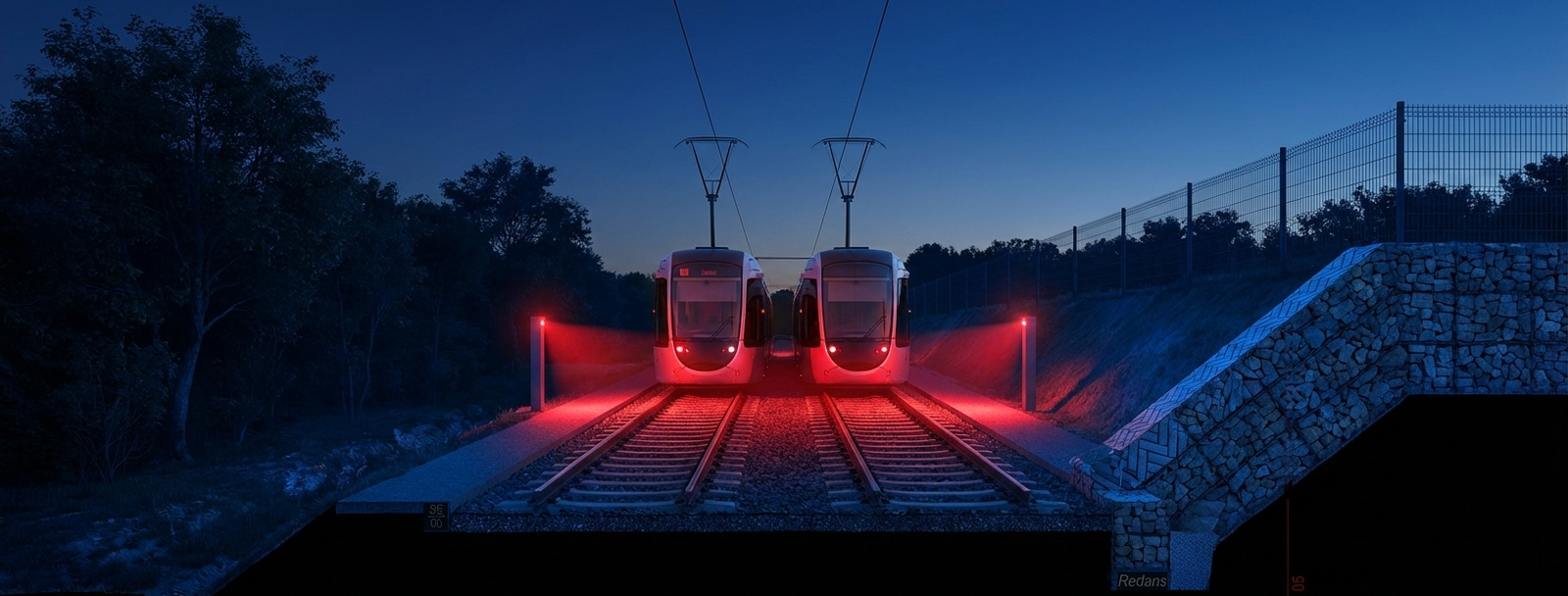
Conceived as a nocturnal experience in its own right, the forest crossing of Tram T13 in the Saint-Germain-en-Laye forest proposes another way of approaching infrastructure lighting, grounded in restraint, precision and deep respect for the site.
Located within a protected forest environment, this five-kilometre sequence raised a delicate challenge: ensuring user safety while preserving the integrity of a sensitive nocturnal ecosystem. Atelier dada’s approach was to illuminate only what is strictly necessary, without spill or unnecessary staging, in order to maintain the natural darkness of the forest and minimise the luminous footprint of the infrastructure.
This ecological intention guided the project from the outset. It takes place in a context where the scientific knowledge currently mobilised to inform such projects remains partial and calls for further investigation under broader observational conditions. While certain studies have clarified specific effects, they do not yet provide fully adequate responses to complex situations where uses, living environments and territorial continuity intersect.
Within this framework, the project introduces a less common hypothesis in public lighting: using light as a progressive crossing tool, capable of accompanying movement, supporting visual adaptation at night, and opening a full-scale field of observation on the interactions between different light spectra and the forest ecosystem.
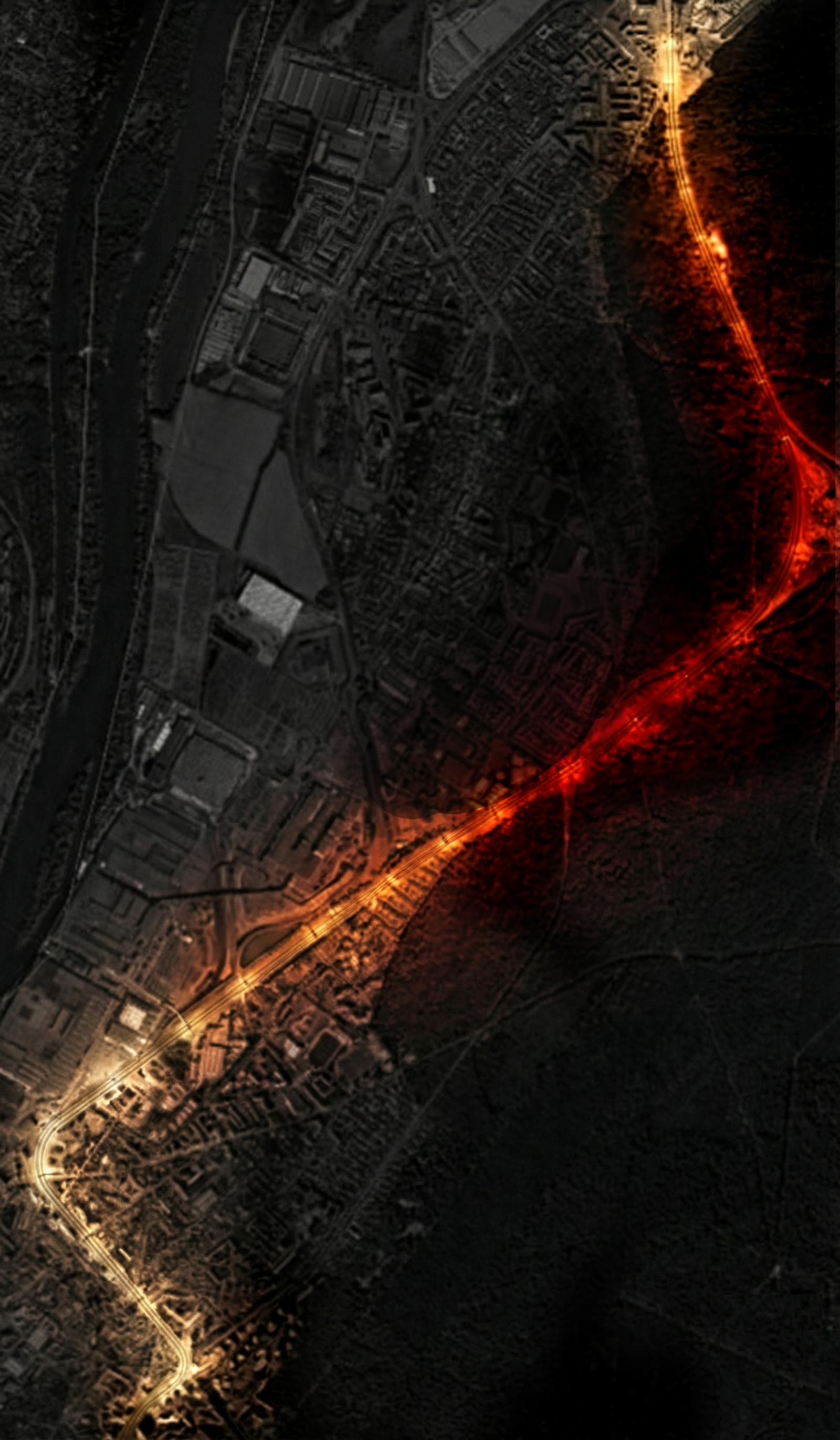
The lighting unfolds as a chromatic crossing structured in sequences. The forest segment lies between two mixed urban areas crossed by the tram before entering the forest and after leaving it. It is in continuity with these urban sequences that 3000 K is introduced, in accordance with the framework set by the client. Within the forest, the crossing shifts toward a warmer and more focused spectral composition, through identifiable steps at 2200 K, 2000 K and 1800 K, complemented by two monochromatic sequences, one in amber and one in red.
This precise spectral composition shapes a crossing that is at once perceptual, legible and rigorous. While aesthetic attention remains fully embedded in Atelier dada’s approach, it is here articulated with the intention of establishing differentiated, comparable and observable conditions over time.
Each sequence thus forms a perceptual atmosphere for the user while simultaneously offering a distinct case study for researchers. Through its scale, continuity and spectral diversity, the crossing becomes a particularly rich experimental field for advancing the understanding of how light affects living environments in a forest context.
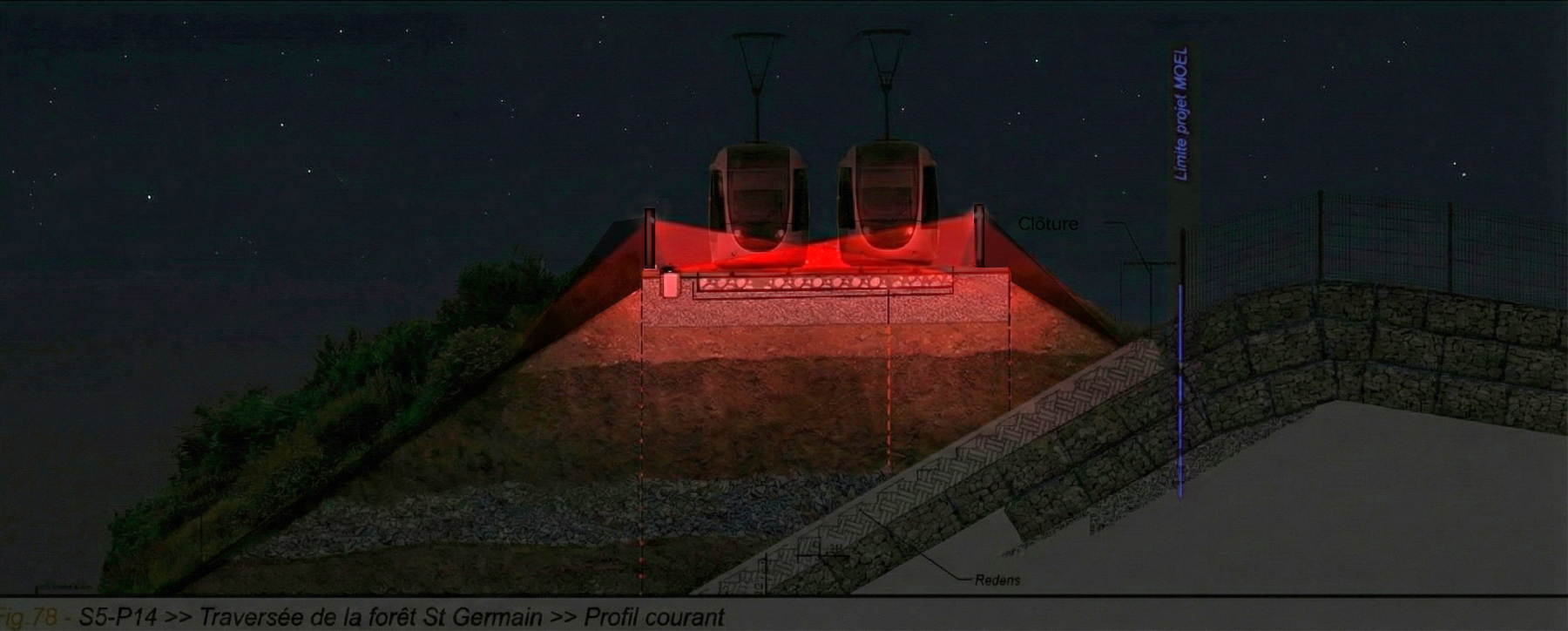
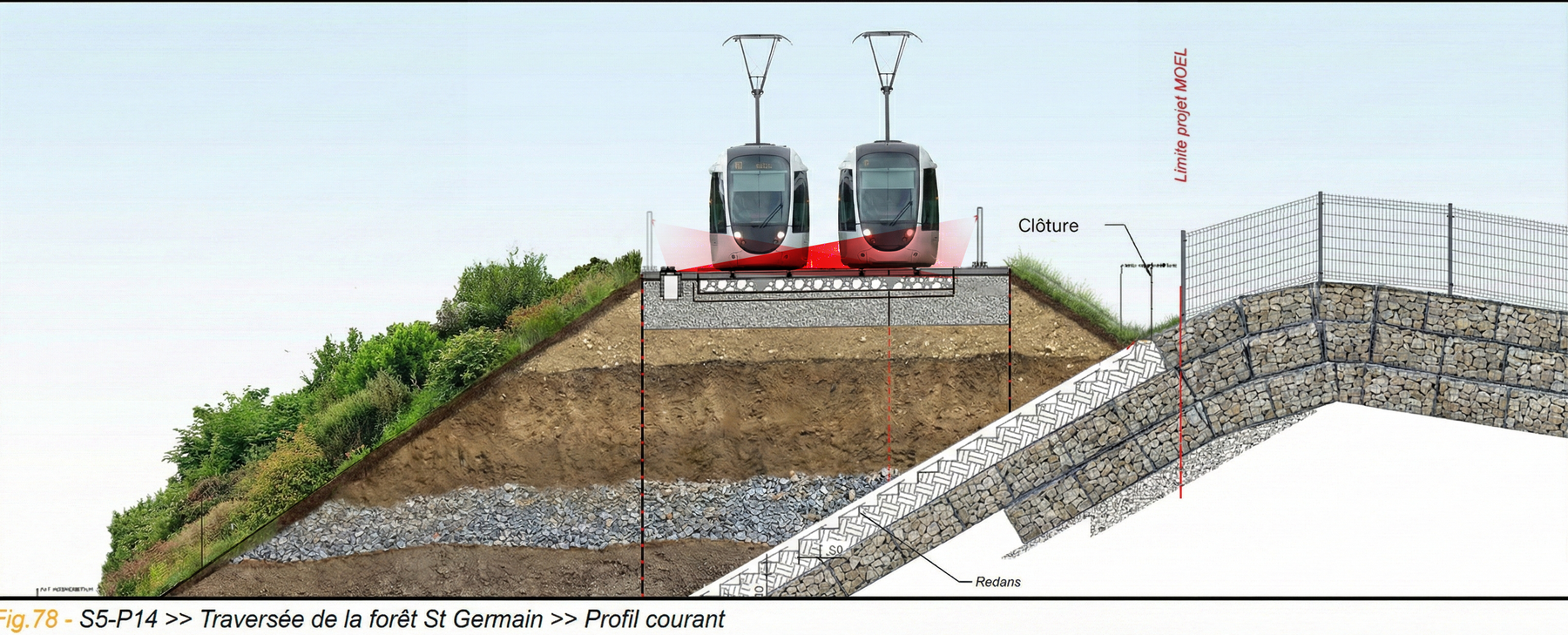
This approach also led to questioning several common reflexes in infrastructure lighting, often based on tall fixtures, generous lighting levels or overly demonstrative control systems. Instead, the project sought a more situated response: lowering the scale of the equipment, strictly focusing the light on the roadway, adopting a very warm spectral composition, controlling illuminance levels and uniformity, and favouring a calm perceptual continuity more compatible with the site’s nocturnal sensitivity.
The project makes it possible to consider observations not only of immediate effects, but also of phenomena related to duration, progressive visual adaptation, the relationship between light and darkness, and the responses of different components of the ecosystem to the spectra encountered.
This visual adaptation can be read at two distinct scales: the rapid one of the passenger travelling through the forest by tram, whose perception shifts continuously along the route, and the slower one of the researcher observing on foot, outside tram operating hours and subject to the client’s authorisation, able to dwell within each luminous sequence and analyse its effects more precisely. The project thus weaves together use, perception and research within a single luminous framework, with the ambition of contributing, over time, to more nuanced and better-grounded ecological lighting approaches.
The system relies on a lighting bollard specifically designed for this project. Its highly asymmetrical optic illuminates only the exact width of the roadway, with no spill into the surrounding forest, ensuring controlled emission and preservation of ambient darkness. Its restrained height and sober expression allow the equipment to recede into the landscape.
Beyond its operational role, this forest crossing suggests that mobility infrastructure can become a field of luminous intelligence, capable of combining safety, discretion, spatial experience and an active contribution to a deeper understanding of ecological lighting and its long-term effects on natural environments.
Project designed in 2019.
Currently under implementation (2026).
Background video embedded from YouTube: “Douze Mois - La forêt enchantée (1980) (French version)”. Source: YouTube.
https://www.youtube.com/watch?v=PiFhSVUU8s4
© 2020 Atelier dada
PREVIOUS PROJECT
A 14 km path of light — BRTS TZen4
NEXT PROJECT
A Harmonious Dance of Light & Shadows — Mondeal Heights
PREVIOUS PROJECT
A 14 km path of light — BRTS TZen4
NEXT PROJECT