Once Upon a Time in Paris — The Track Arches of Gare de l’Est
Interactive installation — sound and light
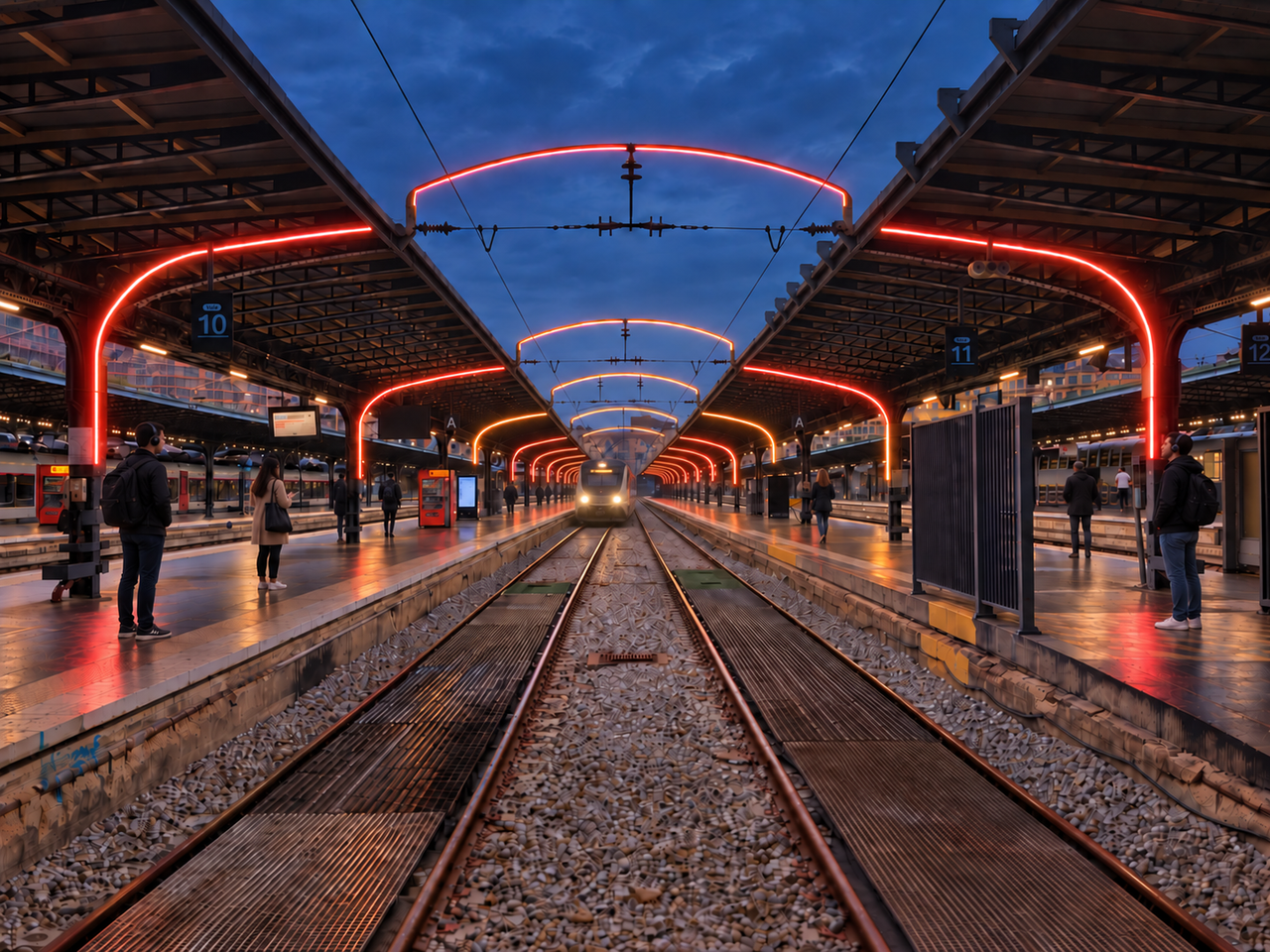
As an extension of Liaison Verte project, the lighting masterplan imagined for the surface-level connection of the Tripôle des gares, Atelier dada developed, on its own initiative, a more intimate and immersive proposal: an interactive sound-and-light installation around the electrified arches of the SNCF tracks at Gare de l’Est.
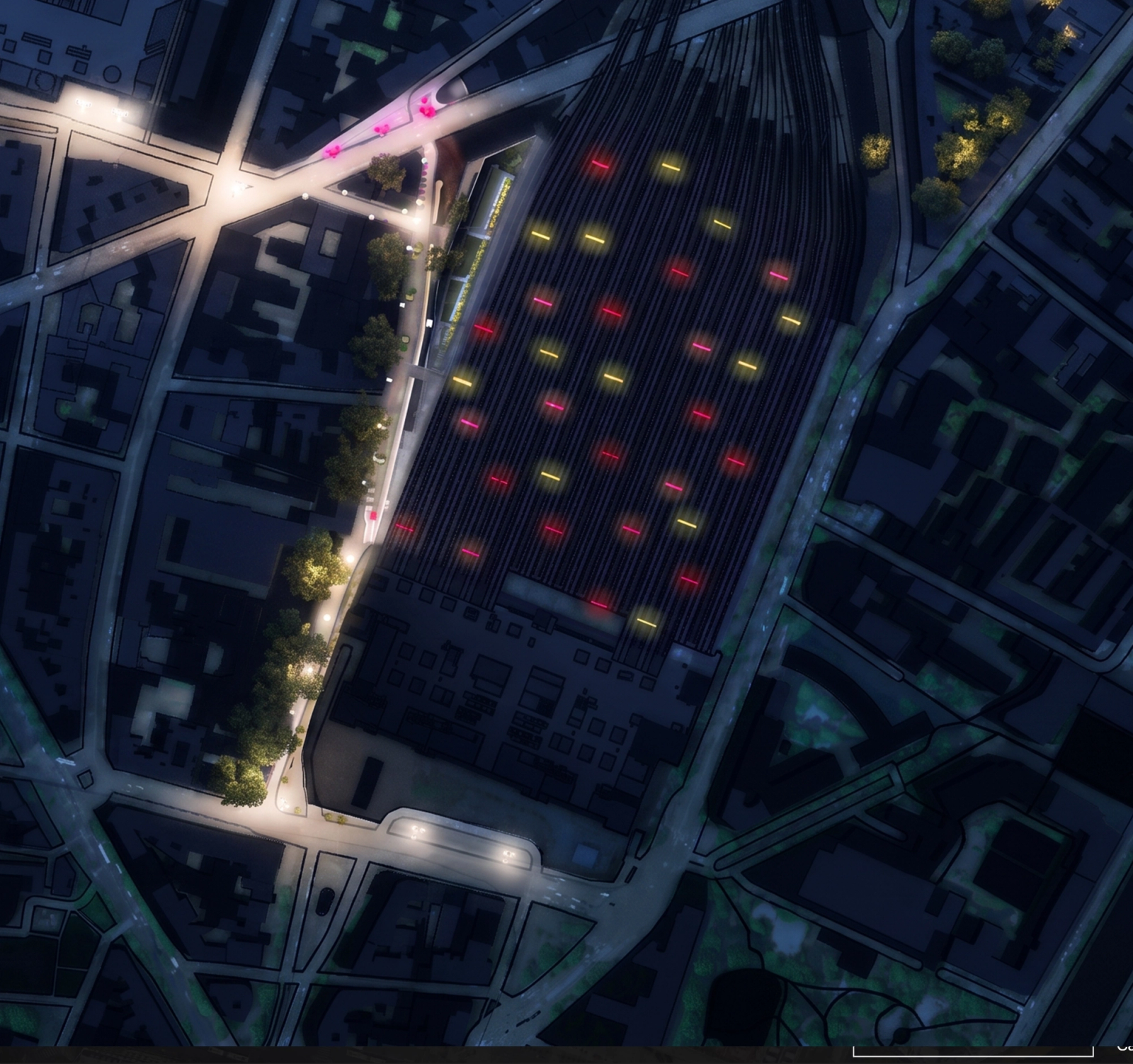
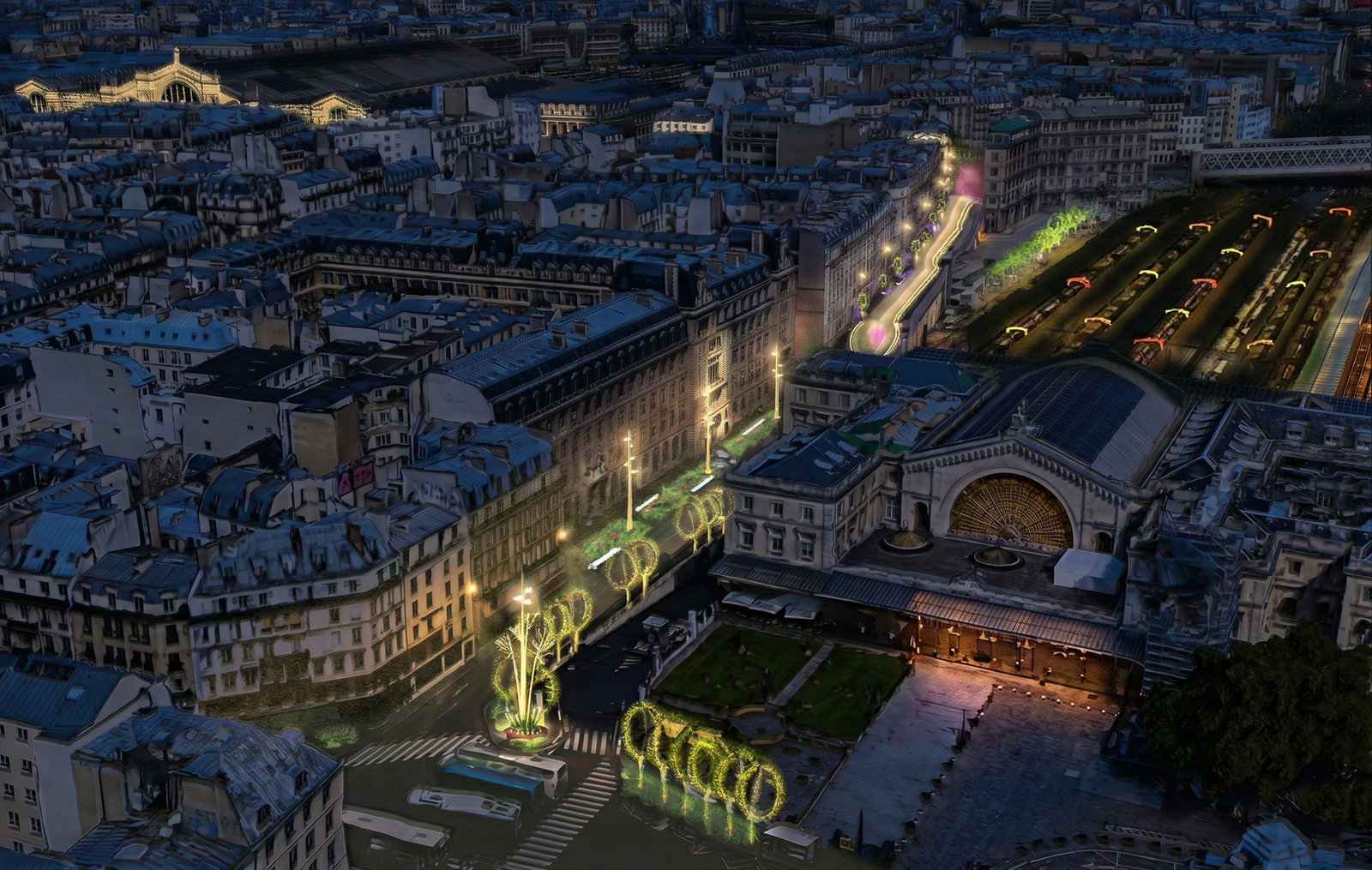
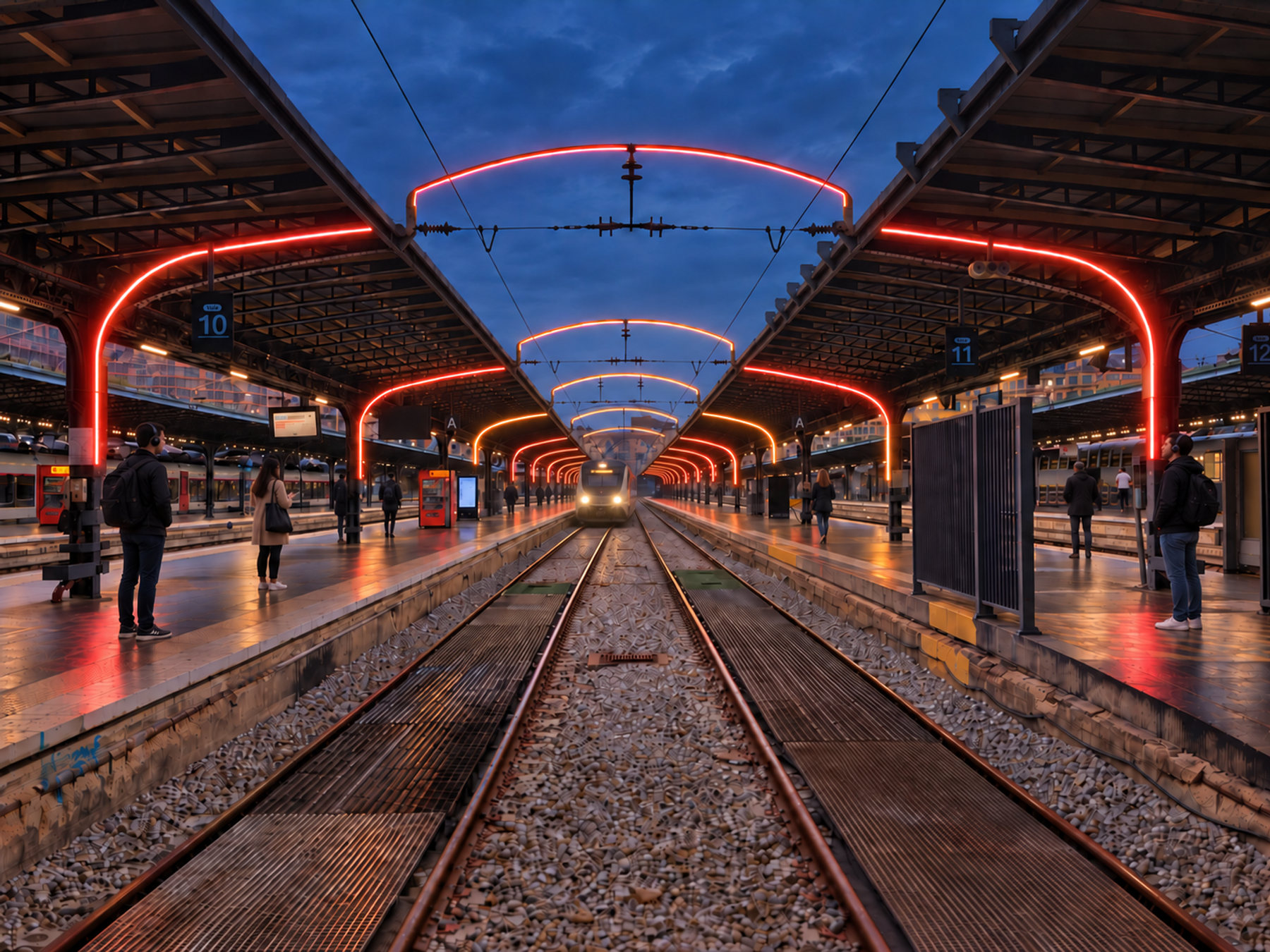
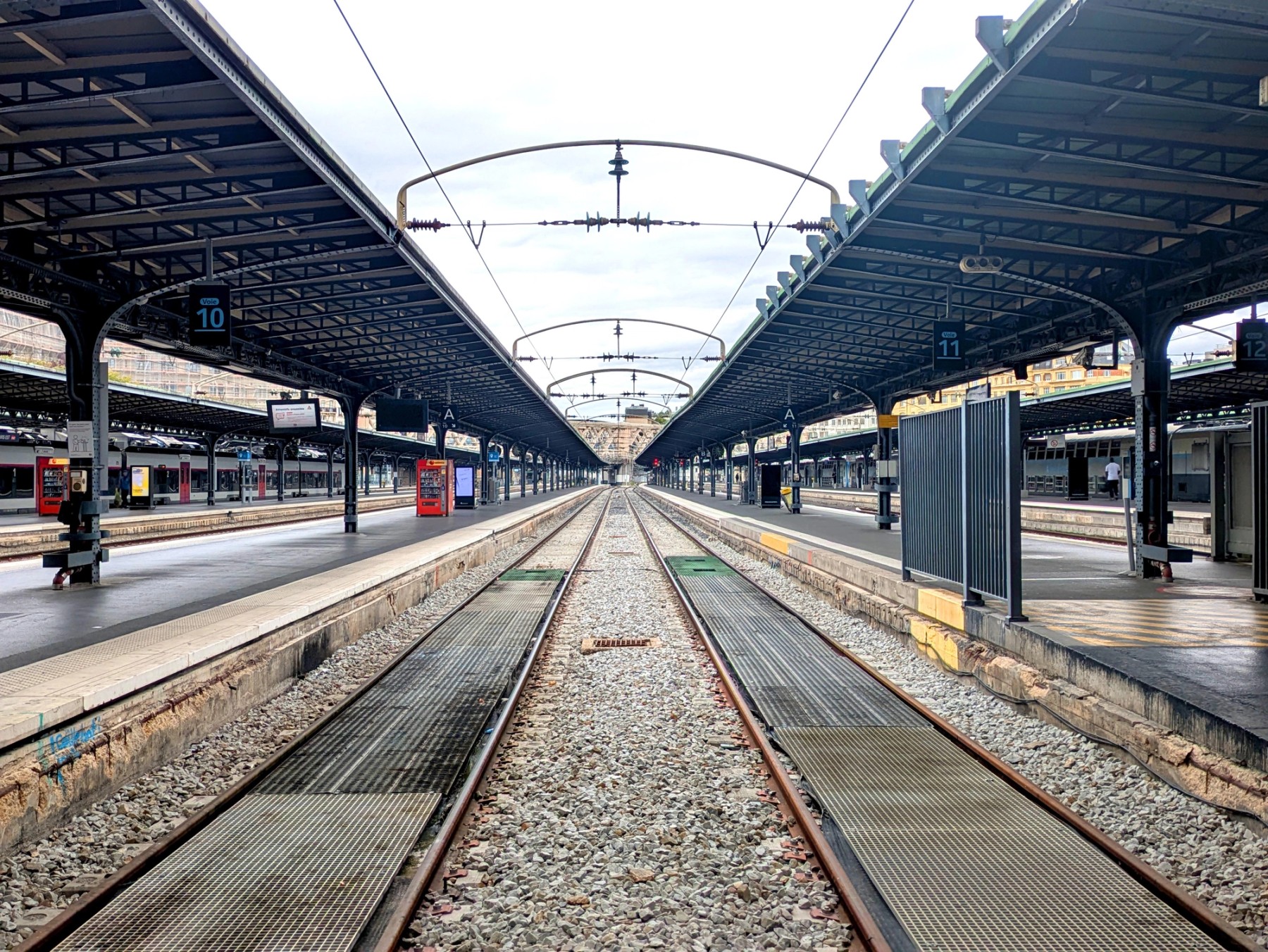
The idea began with a geometry already present. Above the railway fan, the L-shaped platform-canopy structures and the electrified arches set in their continuation form a powerful, almost choreographic repetition. RGBW LED neon lines trace their undersides and perceptually connect these distinct technical elements, recomposing them as a succession of luminous trefoil arches that form a vaulted canopy above the tracks. The intervention reveals an architecture already there and transforms the way it is perceived. Their soft curves give the railway landscape a more enveloping, familiar presence.
The lighting composition formed a warm, vibrant canopy in tones inspired by sunrise, a subtle allusion to the name and location of Gare de l’Est. This luminous presence accompanied the rhythm of the site without erasing its railway character. The perception of the installation shifted with viewpoint and speed: from the platforms and station, the arches receded in depth; from a moving train, they became a kinetic cadence; from upper rue d’Alsace and the planted roof of the OKKO Hotel adjoining its balustrade, they were read at the scale of the railway landscape. The stone lattice bridge opened another view across the crossing.
The installation responded to the rhythms of the site. By day, it remained off on unoccupied tracks; the arrival or departure of a train could briefly activate the corresponding trefoil. In the evening, the arcs beneath the electrified catenary structures carried the lighting sequence inspired by Satie. When a track was occupied, the line beneath its corresponding L-shaped platform canopy lit in turn, completing the trefoil until the track was clear again. The movement of the train briefly inflected the score before the sequence resumed. The actual operation of the station thus became part of the luminous composition.
This perceptual transformation relied on an economy of means: a light intervention on existing structures, dimmable luminous lines, low power, targeted activation according to track occupancy, and controlled luminance. Light distribution was conceived to avoid unwanted upward spill, with components accessible for maintenance. Restraint thus formed an integral part of the project’s architectural expression.
The sound dimension was conceived as an intimate, non-intrusive experience. The lighting sequence followed primarily one of Erik Satie’s Gymnopédies. Passers-by or travellers could have synchronised with this temporality through a dedicated app imagined for the project and listened on their own headphones, without adding amplified sound to the public space.
The choice of Satie was not anecdotal. A major French composer and pianist connected to Paris, Montmartre and the avant-gardes, he opened another dimension of interpretation for the project. Montmartre, on the heights overlooking the Gare du Nord area, extended this cultural geography towards northern Paris, echoing the wider urban strategy for the Tripôle des gares. The project also drew on the luminous memory of neon, familiar to Parisian nights and reinterpreted here through LED technology. The trefoil form, familiar across architectural history, carried its own resonances: the Trinity in Christian tradition, the clover, and the popular association with good luck that it can evoke. These associations opened further layers of memory for each viewer. At the edge of the 18th arrondissement, the installation created real and imagined bridges between eras, districts and layers of collective memory. The Tripôle des gares thus acquired the depth of a cultural and sensory threshold crossed by several memories of Paris.
This proposal was presented to the City of Paris as part of the reflection on the urban connection between Gare de l’Est, Gare Magenta and Gare du Nord. Favourably received, it was intended to be forwarded to SNCF, with the intention of putting Atelier dada in contact with its representatives in view of a possible implementation.
Through OnceUpon a Time in Paris, Atelier dada imagined another way of inhabiting and perceiving an everyday railway landscape. A light intervention on existing structures brought into view an architecture of light already contained in their geometry. The rhythms of trains, music, the changing conditions of day and night, and the memories of Paris became part of a single spatial and sensory composition.
This site-specific vision drew on the ordinary to let the extraordinary emerge. It suggested an urban future in which intelligent use of resources, contemporary creation and cultural heritage could together foster a city more attentive to its uses, more imaginative and more generous in its nocturnal experiences.
A city still capable of inspiring dreams.
© Marie-Ikram Bouhlel I Atelier dada.
The concepts and devices presented in this project are original creations.
They may not be reproduced, adapted or transposed without the explicit consent of the author.
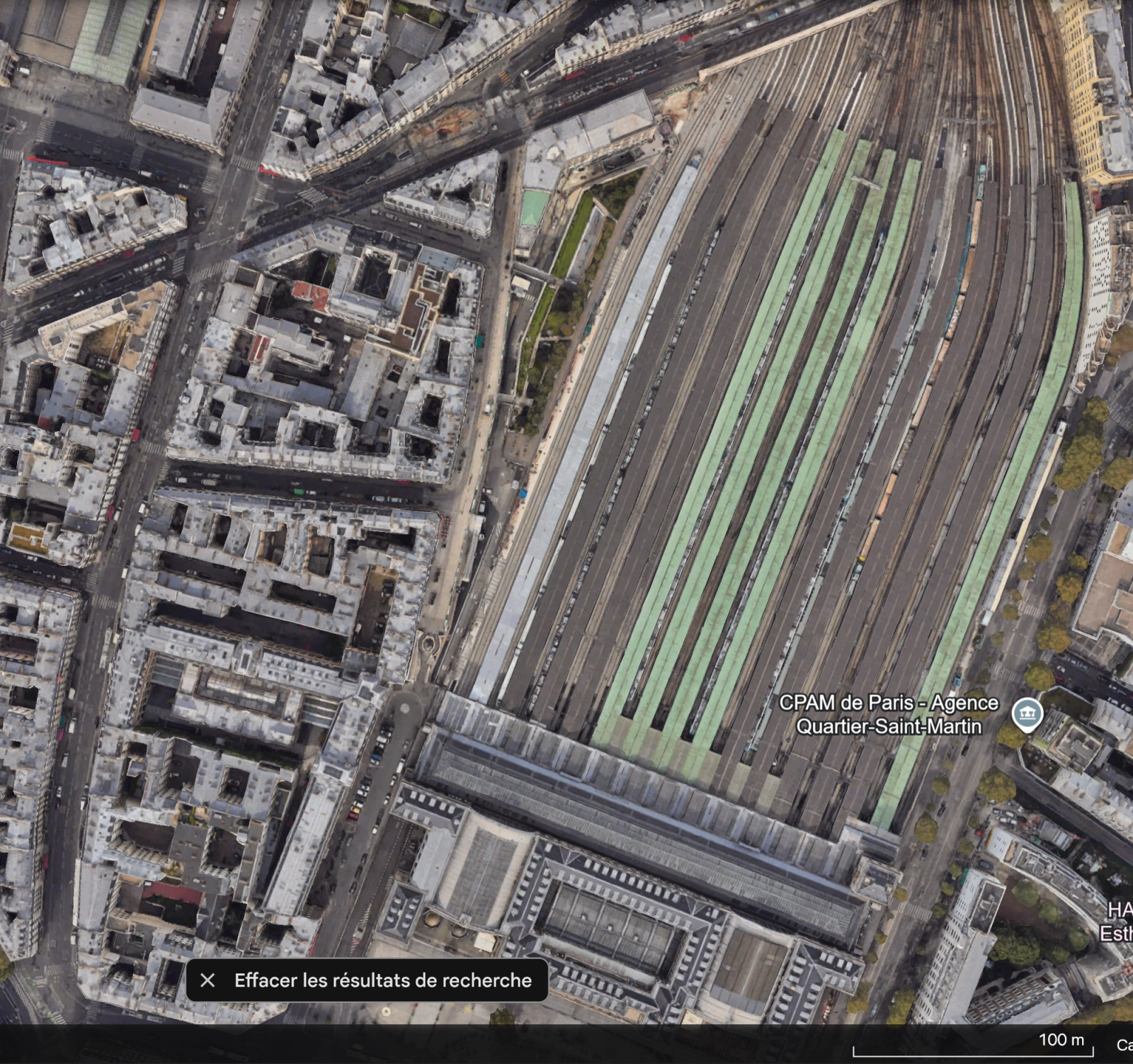
vue en plan, localisation du projet rue d'Alsace © Google Earth