A target too visible
Because it can be seen, light easily becomes one of the first targets of environmental debate. It is made to carry energy losses, carbon impact and the pollution of the night sky, as if public lighting and building illuminations alone concentrated the energy excesses of the city.
The orders of magnitude nevertheless shift the debate.
At the scale of the Greater Paris Metropolis, which brings together around 7.2 million inhabitants, final energy consumption stands at around 100 to 105 TWh/year. Public lighting, when related to the weight of the national lighting stock and to metropolitan density, falls rather within an order of magnitude of 0.25 to 0.5 TWh/year, or approximately 0.25 to 0.5% of this energy mass.
In Ahmedabad, which had around 7.18 million inhabitants in 2021, overall energy consumption is around 27.36 TWh/year. Public lighting would represent a similar order of magnitude, close to 0.5% of total consumption, or around 0.13 TWh/year.
These figures must remain distinct from indoor lighting in buildings, which is generally not isolated as a single item in metropolitan energy balances. But even when included, light remains a minor energy item compared with the major areas of consumption: thermal comfort, equipment, transport, infrastructure, economic and industrial activities.
Environmental debate therefore targets a highly visible element, but one that remains numerically distant from the main centres of urban energy consumption.
As for the night sky, it does not become luminous through light alone. It does so because that light meets an already charged atmosphere: fine particles, dust, smoke, aerosols, emissions from vehicles, industry, construction sites, heating systems and infrastructure. Light then also reveals the air pollution through which it diffuses.
Reducing sky pollution to light alone makes it possible to point to a visible, immediate and convenient culprit. But it avoids looking at the much wider chain of consumption, emissions, technical arbitrations and urban responsibilities.
Night as an urban decision
In the city, after sunset, light above all engages a decision: what an urban space considers worthy of attention.
A threshold, a street, a façade, a tree, a monument, a passage, a periphery, a district, a memory, a use.
To light, reduce, dim, switch off or leave in shadow draws a nocturnal geography of care, priority, and sometimes abandonment.
Dispersed responsibilities
But saying “the city decides” is not enough.
A city does not decide as a single body. Its nights are shaped by an often complex chain of responsibilities: elected officials, cabinets, technical departments, administrative services, project owners, operators, transport authorities, engineering offices, contractors, public procurement frameworks, validation procedures, budgetary arbitrations.
Elected officials give a direction, an ambition, sometimes an agenda. But real decisions also unfold within departments, successive validations, technical notes, postponements, changes of interlocutors, procedural constraints, management habits, the fear of stepping outside the frame, or the difficulty of receiving a proposal that exceeds the strict initial commission.
A concept may be validated, then weakened. A recommendation may be heard, then neutralised. An intention may be fragmented by work packages, schedules, budgets, incomplete handovers or the absence of a responsibility clearly carried through to the end.
This is where light becomes an institutional revealer.
The nocturnal quality of a city also depends on its capacity to assume a decision, to transmit it, to protect it, and to maintain it over time. Without this, the night becomes the result of a dispersed responsibility: everyone intervenes, but no one truly answers for the whole.
Looking before switching on
This is why every lighting project should begin before light.
Before switching on, one must look. Not only see, but perceive, listen, feel, study. Understand sounds, smells, materials, proportions, uses, rhythms, thresholds, fears, attachments, fragilities, visible or erased memories. Understand also what clutters, what lies, what obstructs, what could recover dignity without being disguised.
Lighting design begins in this responsibility of the gaze.
It should not serve to make an urban disorder acceptable, nor to compensate for the absence of transport, cleanliness, facilities, pedestrian continuities or human presence. It can accompany, connect, structure, reveal. It can sometimes repair an injustice of narrative. But it does not replace the city.
Sobriety, abandonment, situated darkness
This is where the question becomes political.
A faintly lit district is not always a sober district. It may be a forgotten district. A switched-off street is not necessarily protected. It may be abandoned. Conversely, a darkness that is thought through, situated, explained and shared can protect the living world, sleep, the sky, and the depth proper to night.
The difference does not lie only in a lighting level. It lies in the decision that produced it, in those who endure or choose it, and in those who bear its consequences.
The question, therefore, is not: should we light more or less?
It is: who decides the night, for whom, and from what understanding of the place?
Connectivity applies an intention
This question becomes even more urgent when the smart city is reduced to the connected city.
Sensors, protocols, dashboards and control scenarios can be useful. They can help adjust levels, adapt schedules, facilitate maintenance, reduce unnecessary consumption, and respond more precisely to the real rhythms of places.
This promise is valuable. Being able to light where needed, when needed, as much as needed, according to real uses, remains one of the most interesting horizons of contemporary lighting design.
But connectivity does not think the city. It applies an intention.
It also implies significant costs: software, hardware, infrastructure, cabling, replacement of existing equipment, qualified maintenance, dependence on systems that are sometimes poorly interoperable, and the fragility of wireless connections. In many contexts, it still remains more of a technical luxury than a shared tool.
A connected city can therefore remain poor in urban intelligence. It can measure without understanding, control without repairing, optimise without caring.
The intelligence of a city begins elsewhere: in the quality of its distances, its ground surfaces, its thresholds, its transport, its facilities, its places of rest, its pedestrian continuities, its shared centralities. It begins in the way the city distributes the dignity of its spaces among those who inhabit them, cross them, maintain them, avoid them or hope for them.
Light comes after this gaze, but it makes it visible.
It reveals whether the city truly supports its uses or merely attempts to stage them. It shows the continuities that work and the ruptures that people bypass. It makes perceptible the places that are loved, the places that are neglected, the spaces one crosses quickly because they offer no reason to slow down.
A thought shaped by places
This reflection has run through Atelier dada since 1999, first in the form of research and reflection workshops, then through its professional structures created in Tunis in 2001, in Paris in 2007 and in Ahmedabad at the end of 2011.
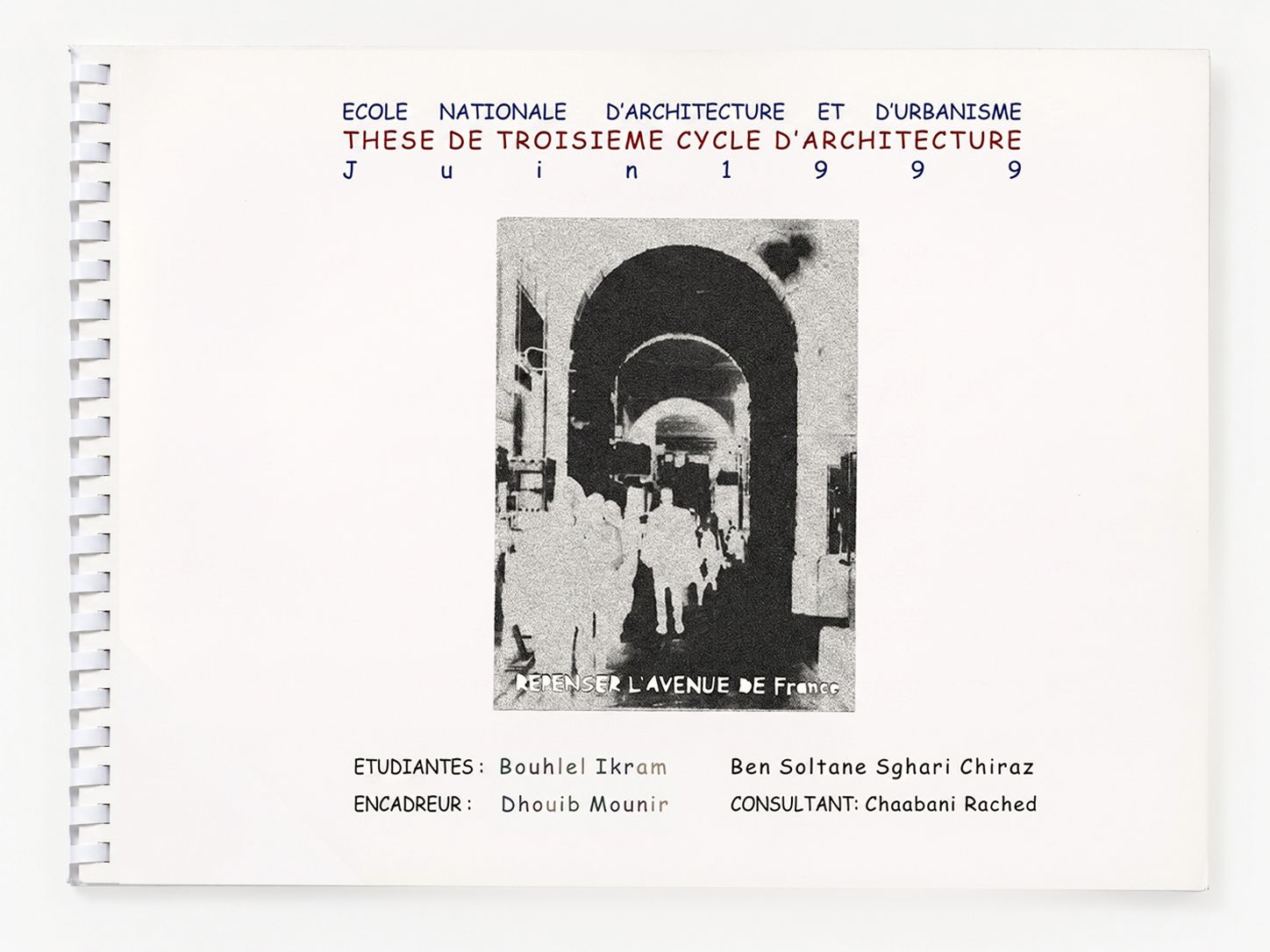
In Tunis, as early as 1999, the question arose around a vacant plot behind the historic arcades of avenue de France, between the colonial centre and the Arab-Muslim centre. The subject was not to beautify an urban void that had become a car park, but to understand what this place could give back to the city: a space of knowledge, observation, youth and continuity between two urban memories.
In Goussainville, the Green Beam stretched between the old town and the new town was not seeking to produce an effect. It re-established a symbolic relationship between two centres, one carrying history and the other the administrative future. Light came to speak of the value of a place that the urban narrative had relegated.
In Ahmedabad, lighting technology could become a tool for architectural and cultural interpretation, provided it merges with the building it served. On Mondeal Square, it was integrated into the sun-brakers to bring forth a large nocturnal jali that changes pattern and graduates along the programmed lighting hours . On Shivalik High Street, it accompanied the silhouette of the tower and its relationship to time. In these cases, technology did not dominate architecture. It extended it.
In Paris, beneath the viaduct of line 2 of the elevated metro, the issue was not only to light an infrastructure. It was to transform an urban cut into an inhabited continuity, a space administratively fragmented between the public transport operator RATP, and the City of Paris, into a place of crossing, daily life and possible collective appropriation.
In Sfax, on Beb Diwan plaza, a threshold between the medina, the ramparts and the contemporary city, nocturnal light could not be conceived as cosmetic treatment. It had to extend a clarification begun by day: recover the coherence of the site, understand what obstructs it, restore dignity to the space before claiming to reveal it at night.
These examples do not say that light can do everything. They say the opposite.
They remind us that light has meaning when it rests on a precise reading of the city. When it knows what it serves. When it does not confuse enhancement with over-brightness, sobriety with blind withdrawal, technology with intelligence, safety with overexposure.
The legible city, the lived city
Nocturnal planning has long borrowed powerful tools of reading from Kevin Lynch: paths, edges, districts, nodes, landmarks. These categories have helped structure the perception of the city, and their contribution remains considerable. But a legible city is not necessarily a liveable city.
Tim Pharoah, rereading Lynch, asks an essential question: do we want a city image or city life? Jane Jacobs, contemporary to Lynch , tried to shift the gaze towards the sidewalks, the presence, the mixed uses, the ordinary eyes, and the fragile trust that holds daily life together. Why was her voice not heard?
For lighting design, the question becomes even sharper at night.
Because night does not judge only form. It tests the city through its real uses. It shows whether ground floors are alive, whether transport allows people to return home, whether paths are continuous, whether thresholds reassure, whether public spaces are maintained, whether districts are treated with the same dignity.
A lighting masterplan should therefore not merely produce a nocturnal image of the city. It should question the nocturnal life it supports or ignores, signal it, and discuss it with project owners before any real intervention.
It is not a matter of opposing light and darkness, connected city and sensitive city, heritage and uses, economy and beauty. These oppositions are too poor. It is a matter of learning to distinguish.
Distinguish in order to decide
Distinguish economy of means from abandonment.
Distinguish protective darkness from imposed darkness.
Distinguish meaningful luminous presence from decorative escalation.
Distinguish technology that serves precision from technology that replaces thought.
Distinguish the enhancement of a place from its cosmetic treatment.
This capacity for discernment should be at the heart of every nocturnal policy.
Less light can be right, or deeply unjust. More light can be necessary, or perfectly useless. Quantity is not enough to define the quality of a nocturnal decision.
What matters is the relationship between the place, the use, the hour, the inhabitants, the living world, memory, the sky, maintenance, the urban project and the chain of responsibility that carries the decision.
Light is a political act because it makes this relationship visible.
It tells what the city chooses to support.
It tells what it accepts to let disappear.
It tells what it no longer wants to see.
It also tells, sometimes, what it tries, belatedly, to bring back into shared attention.
The question to ask before any lighting project is therefore not only technical.
It is civic:
For whom does the city keep watch at night?
And who, within the project chain, truly accepts to carry the answer?
Bibliographic sources
Tim Pharoah, City Image, or City Life? 31st Kevin Lynch memorial lecture, Urban Design Group, London, 14 November 2018. YouTube lecture: https://www.youtube.com/watch?v=9oPCGKXQahk
Kevin Lynch, The Image of the City, MIT Press, 1960.
Jane Jacobs, The Death and Life of Great American Cities, Random House, 1961.
https://metropolegrandparis.fr/sites/default/files/media/document/SDEM%20VF.pdf
https://www.cerema.fr/fr/actualites/chiffres-eclairage-public-cerema-contribue-enquete
https://www.cities-and-regions.org/wp-content/uploads/2023-ahmedabad-climate-resilient-city-action-plan-compressed.pdf
© MI. Bouhlel, Atelier dada. All rights reserved.
The texts, concepts and reflections published on this website may not be reproduced, adapted or distributed without prior permission.